Best High-Interest Savings Accounts in Canada (2026)
!HISA Rate Comparison — June 2026
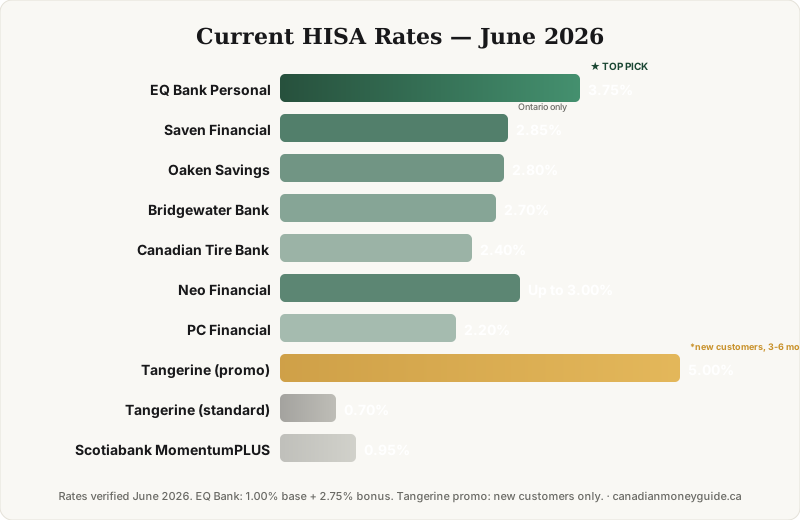
Quick Picks (At a Glance)
| Best For | Account | Current Rate | Monthly Fee |
|---|---|---|---|
| Best overall | EQ Bank Personal Account | 2.75%* | $0 |
| Highest base rate | Saven Financial HISA | 2.85% | $0 |
| Best credit union rate | Oaken Savings Account | 2.80% | $0 |
| TFSA option | EQ Bank TFSA Savings | 1.50%* | $0 |
\ Rates verified September 2026. EQ Bank rate includes 1.00% base + 1.75% bonus interest (conditions apply). Saven Financial available to Ontario residents only. Tangerine standard rate 0.70% effective February 23, 2026; 5.00% promotional offer (5 months) valid Aug 28 – Oct 30, 2026 for new RSP/TFSA. Simplii 4.60% promotional offer valid Aug 1 – Oct 31, 2026 (5 months, eligible deposits up to $200K).*
Comparison Table
| Institution | Account Name | Standard Rate | Promo/Intro Rate | Monthly Fee | Min. Balance | CDIC Insured | TFSA Option |
|---|---|---|---|---|---|---|---|
| EQ Bank | Personal Account | 2.75%* | N/A | $0 | $0 | Yes | Yes |
| Saven Financial | High Interest Savings | 2.85% | N/A | $0 | $0 | Yes** | No |
| Oaken Financial | Savings Account | 2.80% | N/A | $0 | $0 | Yes | Yes |
| Bridgewater Bank | Smart eSavings | 2.70% | N/A | $0 | $0 | Yes | No |
| Canadian Tire Bank | High Interest Savings | 2.40% | N/A | $0 | $0 | Yes | Yes |
| Neo Financial | Neo Savings | 2.00%–2.75%† | N/A | $0 | $0 | Yes | No |
| Wealthsimple | Cash Account | 1.25%–2.25%** | N/A | $0 | $0 | CIPF (not CDIC) | No |
| Wealthsimple | High Interest Savings (HISA) | 2.50% | N/A | $0 | $0 | CIPF (not CDIC) | No |
| PC Financial | PC Money Account | 2.20% | N/A | $0 | $0 | Yes | No |
| Tangerine | Savings Account | 0.70% | Up to 5.00%*** | $0 | $0 | Yes | Yes |
| Simplii Financial | High Interest Savings | ~0.50% | Up to 4.60%*** | $0 | $0 | Yes | Yes |
\ Rates verified September 2026 via provider websites and rate aggregators. EQ Bank rate: 1.00% base + 1.75% bonus (conditions apply). Neo Savings rate is tiered through September 30, 2026: 2.00% base, 2.50% with $5K+ balance, 2.75% with $20K+ balance.† Starting October 1, 2026, Neo ties savings rates to membership tier: Essentials (free) 2.00%, Start ($0 with payroll deposit or $4.99/mo) 2.25%, Build ($9.99/mo) 2.50%, Grow ($14.99/mo) 2.75%. Membership-based fees replace balance-based qualification. Source: neofinancial.com/whats-changing-october-2026.*
\\ Wealthsimple Cash rates: Core clients 1.25%. Premium ($100K+ assets): 1.75%. Generation ($500K+): 2.25%. Rates verified September 2026. CIPF protects investment accounts, not cash balances.
\\\ Wealthsimple launched a separate High Interest Savings Account (HISA) in August 2026 paying a flat 2.50% on all balances, regardless of client tier. Held through Wealthsimple Investments Inc. (CIRO member); CIPF-protected to $1M. Open in the Wealthsimple app (not available on web).*
\\\\ Saven Financial is a division of FirstOntario Credit Union. Deposits insured by FSRA (Ontario provincial insurer), not CDIC.
\\\\\ Promotional rates are for new customers/new deposits, typically 3–6 months. Standard rate applies after promo period. Simplii's 4.60% promo is valid Aug 1–Oct 31, 2026 (5 months, eligible deposits up to $200K). Source: simplii.com/en/special-offers.*
Best By Use Case
Best Overall: EQ Bank Personal Account
Rate: 2.75%* | Fee: $0 | Minimum: $0
Why it's our top pick:
EQ Bank consistently offers competitive rates without promotional gimmicks. The rate you see is the rate you get — no introductory periods, no "new money only" restrictions. CDIC-insured up to $100,000. Also offers a TFSA version (currently at 1.50%*). Note: EQ Bank's rate is no longer the highest on the market — Saven Financial (2.85%) and Oaken (2.80%) offer slightly higher rates. We still recommend EQ Bank for its combination of competitive rate, no-fee banking, and CDIC coverage.
Best for: Emergency funds, general savings, anyone who wants a set-it-and-forget-it account.
Caveats: Online-only — no physical branches. No debit card (transfers only).
Earn Top Interest at EQ Bank →Opens in a new window on EQ Bank's secure website
Best for TFSA Emergency Fund: EQ Bank TFSA Savings
Rate: 1.50%* | Fee: $0 | Minimum: $0
Why it's our top TFSA pick:
EQ Bank's TFSA Cash Savings Account lets you earn tax-free interest on your emergency fund. However, note that the TFSA rate of 1.50% is now significantly lower than the regular Personal Account rate of 2.75%. If maximizing returns matters more than tax savings, consider keeping your emergency fund in EQ Bank's Personal Account instead — especially if you're in a lower tax bracket.
Best for: Canadians with unused TFSA room who want tax-free emergency fund growth.
Caveats: Withdrawals from a TFSA don't permanently lose room (it's added back January 1 of the following year), but you can't re-contribute until then. Plan your withdrawals accordingly.
Earn Top Interest at EQ Bank →Opens in a new window on EQ Bank's secure website
Best for Newcomers to Canada
What newcomers should look for: No-fee banking with easy account opening — no Canadian credit history required, no minimum balance, and free Interac e-Transfers. Most online banks accept government-issued ID. The Big Five (RBC, TD, Scotiabank, BMO, CIBC) offer newcomer packages with 1–2 years of free banking and a first Canadian credit card, but charge monthly fees after the intro period.
Best for: Newcomers building their first Canadian emergency fund without locking into a big-bank fee structure.
Our pick for newcomers: EQ Bank's Personal Account pays 2.75% interest with no monthly fee, no minimum balance, and CDIC insurance. Tangerine offers a promotional rate up to 5.00% for 5 months on new RSP/TFSA accounts, with unlimited free Interac e-Transfers. Both accept government-issued ID and have no Canadian credit history requirement.
Earn Top Interest at EQ Bank →No monthly fee, no minimum balance, CDIC insured. Opens on EQ Bank's secure website.
Best for Promotional Rate Hunters: Tangerine Savings
Standard rate: 0.70% | Promo rate: Up to 5.00%* (5 months for new RSP/TFSA Savings Accounts; Tangerine's current top offer applies to registered accounts, not the non-registered Savings Account)
Why it's worth considering:
Tangerine regularly offers promotional rates of 4.00–5.50% for new customers (3–6 months). If you're willing to move your money when the promo ends — or negotiate an extension — Tangerine can be a high-yield home for your emergency fund.
Best for: People who don't mind monitoring rates and moving funds when promos expire.
Caveats: The standard rate is among the lowest on this list (0.70%). If you set it and forget it, you'll earn very little. Promo rates apply to "new money" only — existing balances may not qualify.
Claim Your Tangerine Bonus →Use Orange Key: 38687402S1 for a cash bonus. Opens on Tangerine's secure website.
How We Picked These Accounts
We evaluated accounts using the following criteria:
| Criterion | Weight | What We Looked For |
| Interest rate | High | Published standard rate (not promo-only) |
| Fee structure | High | No monthly fees, no minimum balance requirements |
| Liquidity | Critical | Easy transfers in and out, no lock-in periods |
| CDIC insurance | High | Coverage up to $100,000 per category |
| TFSA availability | Medium | Option to hold in tax-free account |
| Accessibility | Medium | Online access, mobile app, transfer speed |
| Promotional honesty | Medium | Clear disclosure of when promo rates end |
Accounts we excluded: Those with tiered rates that require high minimums (e.g., $5,000+ for top tier), accounts locked to specific provinces, or accounts from institutions with consistently poor user ratings.
CDIC Insurance: What You Need to Know
!CDIC Deposit Insurance Coverage Diagram
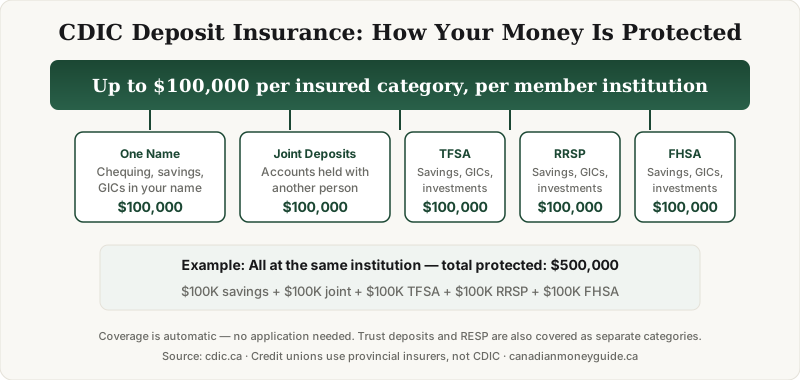
The Canada Deposit Insurance Corporation (CDIC) protects eligible deposits up to $100,000 per insured category, per member institution.
Categories include:
- Deposits in one name
- Joint deposits
- TFSA deposits
- RRSP deposits
- FHSA deposits
This means: You could have $100,000 in a regular savings account, $100,000 in a TFSA savings account, and $100,000 in a joint account — all at the same institution — and all $300,000 would be covered.[1]
Credit unions are typically insured by provincial deposit insurers (e.g., DICO in Ontario, CUDIC in BC), not CDIC. Coverage terms vary by province.[2]
Frequently Asked Questions
What's a "good" HISA rate in Canada in 2026?
As of Q3 2026, anything above 2.50% is competitive. The Bank of Canada policy rate sits at 2.25% (as of September 2, 2026 — seventh consecutive hold), so HISA rates typically track 0.25–1.00% above that, depending on the institution.[3]
Should I chase the highest rate?
If the difference is less than 0.50%, the convenience of staying with a bank you already use probably outweighs the extra interest. On a $10,000 balance, 0.50% is $50/year. If the difference is 1.00%+, switching may be worth the effort.
Are online-only banks safe?
Yes. Online-only banks in Canada (EQ Bank, Tangerine, Simplii, Motive, Oaken) are either CDIC-insured banks or subsidiaries of CDIC-insured institutions. Your deposits are protected up to the same $100,000 limit as at major banks.
Can I open multiple HISAs?
Yes. There's no limit on how many savings accounts you can hold. Some people open accounts at multiple institutions to maximise CDIC coverage or take advantage of promotional rates.
Next Steps
How to Build an Emergency Fund in Canada (Full Guide) →
Once you've chosen an account, here's the step-by-step plan to actually fill it.
Should you hold your emergency fund in a TFSA HISA or a standard taxable account? We break down the trade-offs.
Canadian Money Guide is a research-driven publication, not a financial advisor. Rates are accurate as of the date shown and are subject to change. Always verify current rates, terms, and CDIC coverage directly with the provider before opening an account. This page contains links to financial institutions — we may earn a commission from some of these links at no cost to you. See How We Research and our Affiliate Disclosure.
Footnotes
- CDIC deposit insurance covers up to $100,000 per insured category, per member institution. Categories include deposits in one name, joint deposits, TFSA, RRSP, FHSA, trust deposits, and more. Source: cdic.ca ↩
- Provincial deposit insurers vary by province. Ontario: FSRA (formerly DICO, unlimited for non-registered, $250K for registered). BC: CUDIC (unlimited). Manitoba: DGCM (unlimited). Quebec: AMF ($100K). ↩
- Bank of Canada policy interest rate as of September 2, 2026: 2.25% (seventh consecutive hold). Source: bankofcanada.ca ↩